
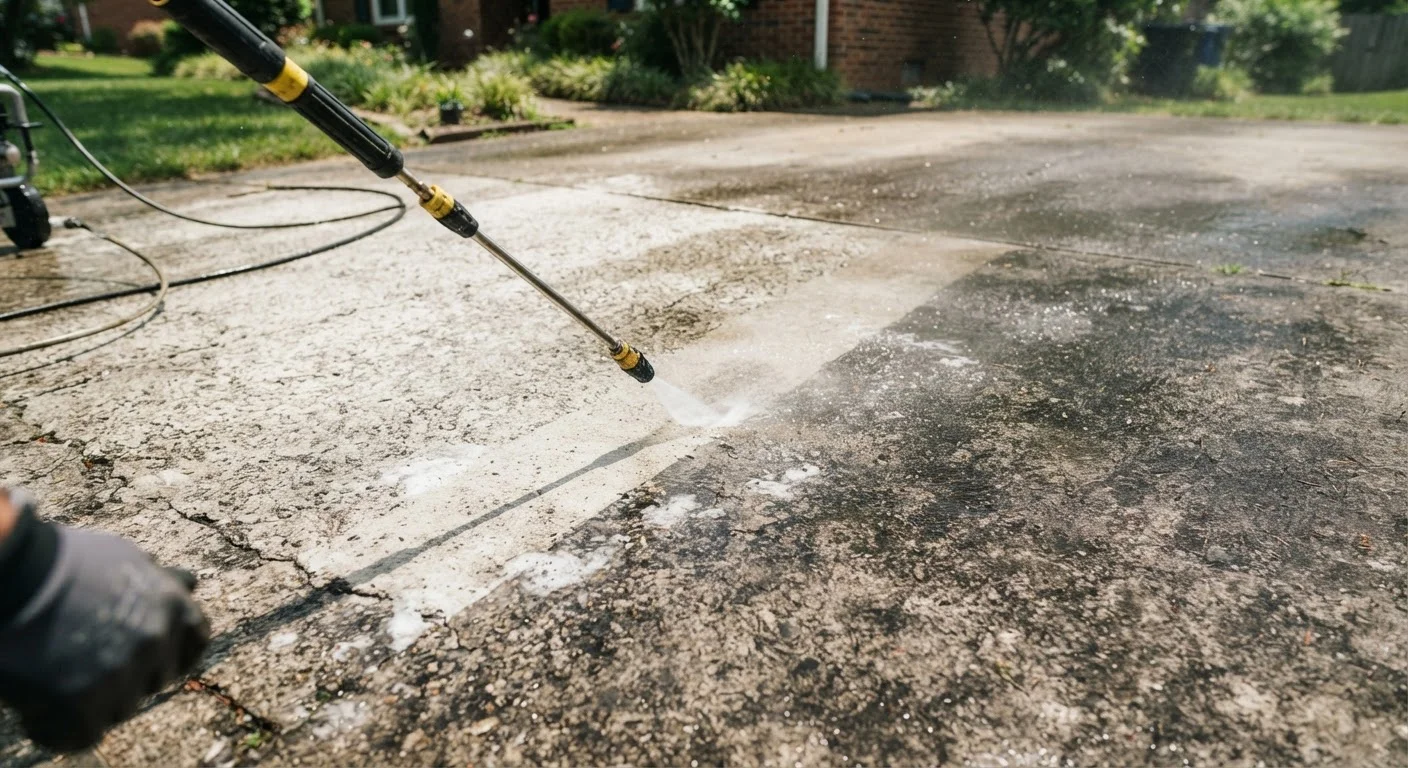
Why concrete and pressure washing are a complicated pair
Concrete looks tough enough to handle anything, and in many ways it is. But it is also a porous material with a surface that can be physically eroded by water at high velocity. Most homeowners who rent or buy a pressure washer for the first time operate under a set of assumptions that feel logical but regularly lead to surface damage, wasted water, and results that look worse than expected.
Understanding what pressure washing actually does to concrete at a physical level changes how you approach the job. Water forced through a narrow nozzle at high speed creates a cutting action. On the right settings with the right technique, that action lifts embedded dirt, oil stains, and organic growth without disturbing the concrete matrix. On the wrong settings, it strips the cement paste from the surface, exposing aggregate and leaving a pitted, rough texture that traps dirt more aggressively going forward.
Myth
The higher the PSI, the better the clean. Renting the most powerful machine available will get concrete cleaner faster.
Fact
For residential concrete, 2,000 to 3,000 PSI is generally sufficient. Pressures above that range can etch the surface rather than clean it.
Concrete driveways and patios in residential settings are typically finished at a strength that responds well to moderate pressure. The Portland Cement Association notes that the surface paste layer of concrete is vulnerable to abrasion, and repeated high-pressure washing strips it progressively. Once the paste layer is gone, the coarser aggregate underneath becomes exposed, creating a rough surface that collects debris more easily and is more susceptible to staining. Using moderate pressure with proper technique produces a cleaner result without long-term surface degradation.
Myth
Pressure washing concrete as often as possible keeps it in the best condition. Frequent washing prevents long-term staining.
Fact
Washing concrete too frequently accelerates surface wear. Most residential surfaces benefit from one or two washes per year.
Each pressure washing session removes a small amount of the cement paste surface, even when performed correctly. Over-washing compounds this effect. Organic growth such as algae and moss needs time to establish before it can be effectively treated, and washing bare concrete repeatedly without cause simply introduces unnecessary mechanical wear. For most driveways and patios, one thorough wash in spring and one in fall is adequate maintenance. Spot-treating individual stains between sessions is preferable to full-surface washing.
Myth
You can hold the nozzle close to the surface for tough stains without causing damage, as long as you keep moving.
Fact
Distance from the surface is one of the most important variables. Even brief contact at close range with a narrow nozzle can etch concrete.
Pressure at the nozzle tip spreads as it travels through air. The closer the nozzle to the surface, the more concentrated the force on a smaller area. Etching from close-range washing shows up as visible lines or swirl marks in the concrete, especially on smoother finishes. These marks are permanent. Keeping the wand at a consistent 12 to 18 inches from the surface and using a 25-degree nozzle prevents this outcome without sacrificing cleaning effectiveness.
Myth
Pressure washing removes all types of stains equally. If it does not come out, more pressure will eventually break it loose.
Fact
Different stains require different treatments. Oil, rust, and biological growth each respond to specific chemistry, not increased force.
Water pressure is effective at dislodging loose dirt, mud, and surface-level organic material. It is not effective at dissolving substances that have bonded chemically with concrete pores. Oil requires a degreasing surfactant. Rust stains respond to oxalic acid-based cleaners. Efflorescence (the white mineral deposits that form on concrete surfaces) needs a mild acid wash, not high pressure. Attempting to blast these stains away with increased PSI risks surface damage without removing the underlying stain. Identifying the stain type before washing leads to better results with less force.
Myth
Any pressure washer nozzle will work on concrete. The color coding on nozzles is just a manufacturer preference.
Fact
Nozzle angle directly controls how pressure is applied, and choosing the wrong one causes irreversible surface damage.
Pressure washer nozzles are color-coded by spray angle: red (0 degrees), yellow (15 degrees), green (25 degrees), white (40 degrees), and black (65 degrees, used only for applying detergent at low pressure). For concrete cleaning, the green 25-degree nozzle handles general cleaning, and the yellow 15-degree nozzle can address stubborn spots from an appropriate distance. The red 0-degree nozzle should never be used directly on concrete surfaces. It concentrates the full water force into a pinpoint capable of cutting into the concrete matrix, leaving permanent gouges or lines.
Technique and timing details that matter
Even after correcting the main misconceptions, a few practical details separate a clean result from a damaged one.
Nozzle selection is where most errors begin. A 0-degree (red) nozzle concentrates all water force into a pinpoint and should not contact concrete surfaces. A 15-degree (yellow) nozzle works for stubborn stains when kept at the right distance. A 25-degree (green) nozzle handles general surface cleaning without the risk of etching. Using the wrong nozzle at close range is the single fastest way to permanently scar a driveway.
Working distance matters as much as PSI. Keeping the wand 12 to 18 inches from the surface for most residential concrete gives adequate cleaning force without concentrating pressure into a damaging stream. Moving the wand in overlapping, consistent passes prevents streaking and ensures even pressure exposure across the slab.
Pre-treating oil stains with a concrete degreaser before washing improves results more than increasing pressure does. High pressure does not dissolve oil: it disperses it. A surfactant loosens the bond between oil and concrete pores, and then the washer rinses it away cleanly.
Do not pressure wash decorative or stamped concrete
Stamped, stenciled, and decorative concrete finishes have a thinner surface layer and are more vulnerable to pressure washing damage than standard broom-finished slabs. High pressure can strip sealers, lift color hardeners, and damage the pattern texture. Consult a concrete contractor before washing these surfaces, and use a low-pressure rinse with a wide nozzle as a starting point only.
After washing, allow the surface to dry fully before applying a penetrating concrete sealer. Sealers fill surface pores, reduce future staining, and slow moisture infiltration that causes freeze-thaw cracking in cold climates. This step is often skipped and consistently extends the life and appearance of the concrete.