
Why tire care pays off in real dollars
A mid-range set of tires for a family sedan or SUV runs several hundred dollars installed, and premium options can push past a thousand. That cost repeats every four to six years for most drivers, sometimes sooner if tires wear unevenly. Simple maintenance habits stretch that interval without requiring any special tools or mechanical skills.
Tire wear is mostly predictable. Pressure that is too low generates excess heat and scrubs the outer edges faster than normal. Alignment problems pull a tire sideways as it rolls forward, grinding one edge down while the rest of the tread stays relatively fresh. Neglecting rotation lets front tires, which handle steering and most braking forces, wear far ahead of the rears. Each of these problems compounds the others. For families tracking costs across a vehicle, this is one area where routine maintenance awareness directly reduces spending.
Pressure checks: the lowest-effort habit with real impact
Tire pressure changes about one PSI for every 10-degree Fahrenheit shift in temperature, which means a tire that was fine in September may be noticeably underinflated by January. The correct pressure for your vehicle is printed on a sticker inside the driver's door jamb, not on the tire sidewall. The sidewall number is the tire's maximum pressure rating, which is different.
Check all four tires (and the spare, if it is a full-size) when they are cold, meaning the vehicle has not been driven more than a mile or two. A basic digital gauge costs a few dollars and gives a more accurate reading than most gas station gauges. Monthly checks are enough for most drivers; check again after any significant temperature drop.
Running tires 6 PSI or more below the recommended level is classified as significantly underinflated and can affect handling and wear rates. Overinflation is also a problem: an overinflated tire contacts the road on a smaller center strip, wearing faster in the middle and reducing grip.
Rotation schedules that actually protect your investment
Tire rotation moves each tire to a different position on the vehicle, so wear is distributed more evenly over the full set. The standard recommendation from most vehicle manufacturers is every 5,000 to 7,500 miles, which roughly lines up with oil change intervals for many modern vehicles. Combining the two services saves a trip.
The rotation pattern depends on whether the vehicle is front-wheel drive, rear-wheel drive, all-wheel drive, or four-wheel drive, and whether the tires are directional or non-directional. A qualified tire technician will know the correct pattern. If you own a high-mileage vehicle, consistent rotation becomes more important because aging tires with uneven wear are harder to replace one at a time and still maintain balanced handling.
Skipping rotations for 15,000 or 20,000 miles is common and noticeably shortens tire life. The front tires on a front-wheel-drive vehicle can wear twice as fast as the rears without rotation.
Alignment and balance: what they do and when to check
Wheel alignment refers to the angles at which your tires contact the road. Hitting a large pothole, a curb, or road debris can shift these angles out of spec. You may notice the car pulling to one side, or the steering wheel sitting off-center when driving straight. Tread wear that looks like feathering on one edge of a tire is another sign.
Alignment should be checked at least once a year for most drivers, or any time the vehicle hits something hard enough to jolt the steering. The check itself is not expensive; catching the problem early avoids the tire wear costs that follow from ignoring it.
Wheel balancing is a separate service. An unbalanced wheel vibrates at certain speeds, which accelerates wear and makes the ride uncomfortable. Balancing is typically done when new tires are mounted and can be done again if vibration develops later. Both alignment and balancing are services a qualified mechanic should handle.
All-wheel drive does not eliminate rotation needs
Some AWD owners assume that because power goes to all four wheels, wear is automatically even. It is not. AWD systems distribute torque, but weight distribution and steering forces still cause the front tires to wear faster than the rears on most vehicles. Rotation intervals for AWD vehicles are often tighter than for two-wheel-drive models; check your owner's manual for the manufacturer's specific recommendation.
For families planning longer drives, well-maintained tires also contribute to safety margins. The cost considerations for road trips are real, and a blowout or unplanned tire replacement mid-trip adds both expense and stress.
Reading tread wear and knowing when to replace
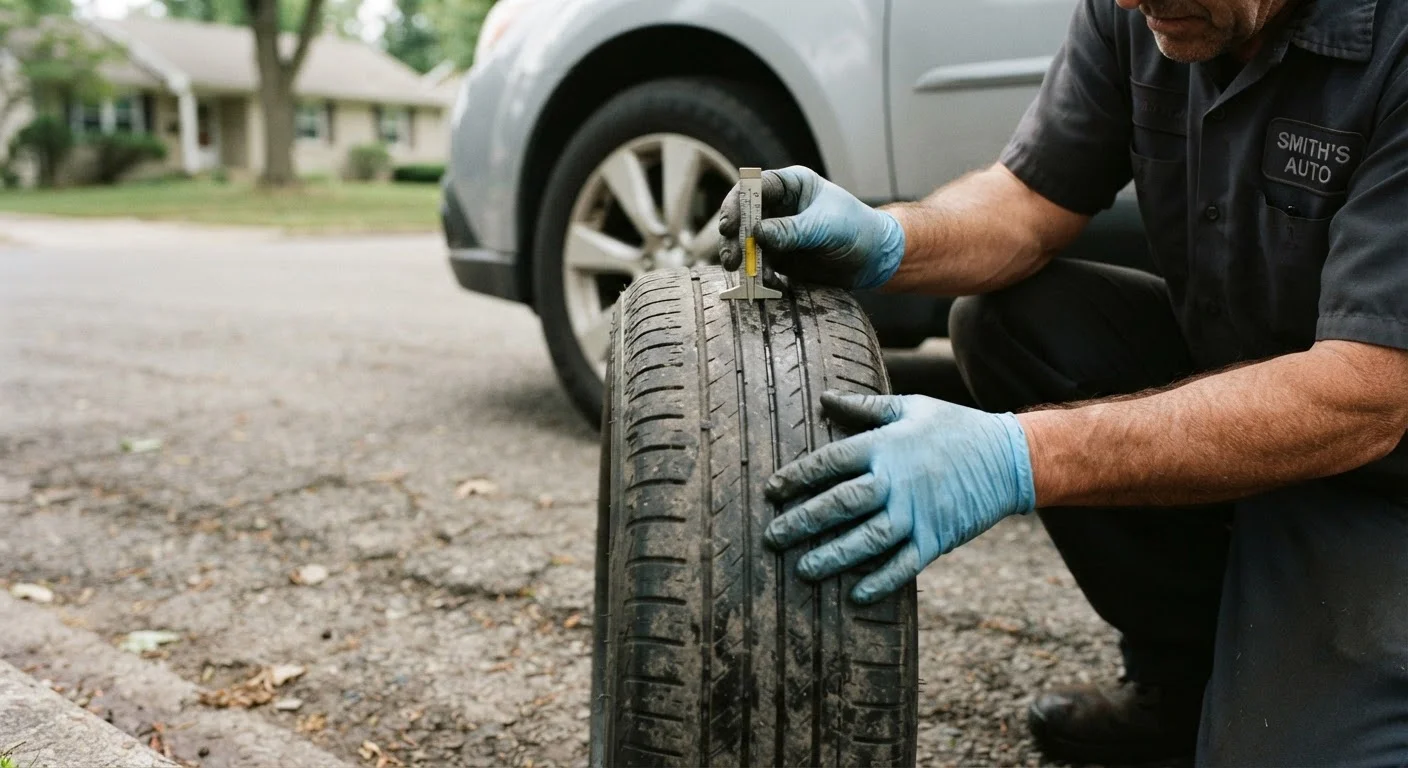
The legal minimum tread depth in the U.S. is 2/32 of an inch. Most tire manufacturers and safety organizations suggest replacing tires at 4/32 of an inch, because wet-weather stopping distances increase noticeably below that level. A quarter placed into the tread groove (George Washington's head going in first) gives a rough 4/32 indicator. A penny indicates the 2/32 legal minimum.
Tires also degrade with age regardless of tread depth. Most manufacturers recommend replacing tires after six to ten years from the manufacture date, even if they look fine. The date is molded into the sidewall as a four-digit code (week and year) inside an oval stamp.
Uneven wear patterns are useful diagnostic information. Wear only on the edges usually points to chronic underinflation. Wear in the center points to overinflation. One-sided wear points to an alignment problem. Catching these patterns early lets you correct the underlying issue before it ruins the next set of tires too. This kind of attention fits the same logic as understanding your actual service intervals: spending a little attention regularly avoids a larger bill later.