
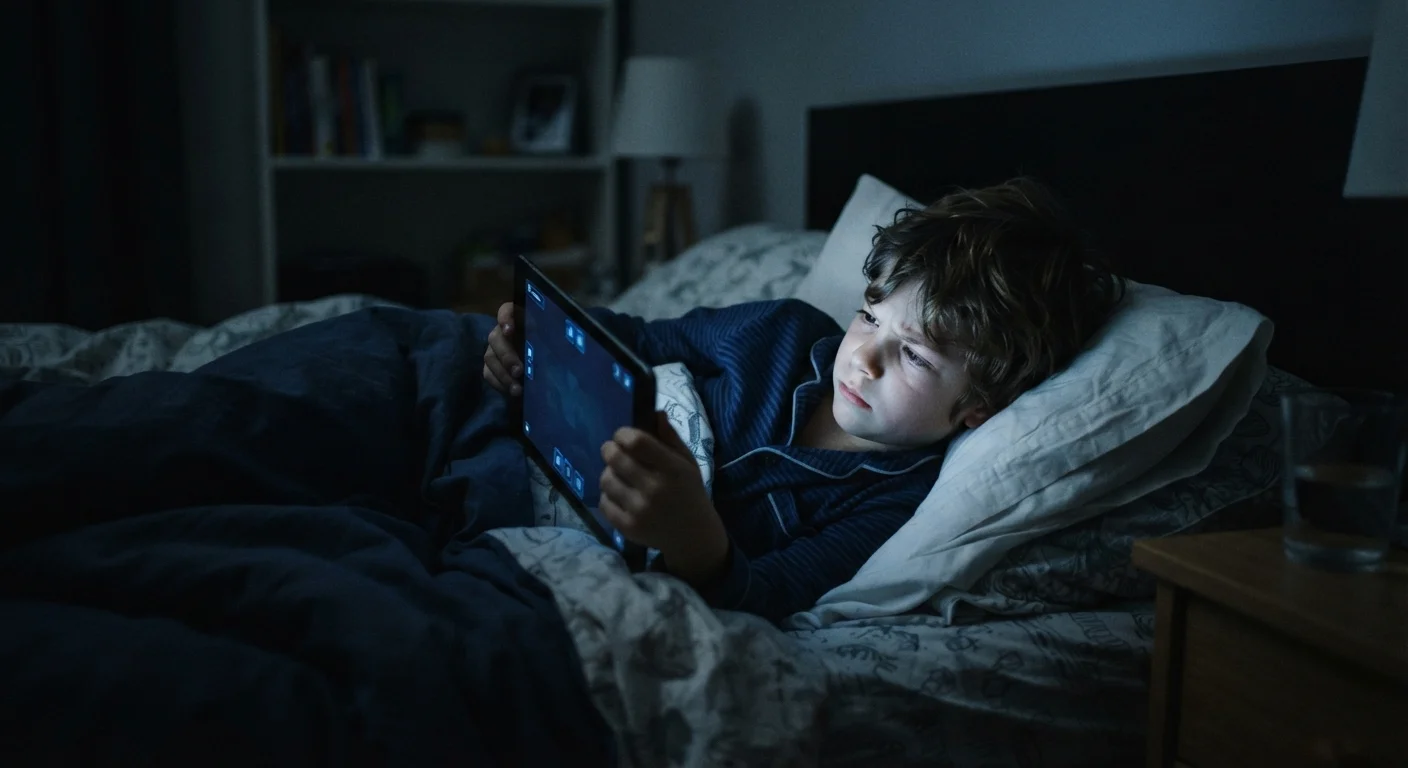
Why screen time disrupts children's sleep
Most parents know that screens and sleep do not mix well, but the reasons are worth understanding clearly. When a child looks at a bright screen in the evening, the light-detecting cells in their eyes send signals to the brain's suprachiasmatic nucleus, the region that governs the body's internal clock. Bright light at that hour suppresses melatonin production, which is the hormone that signals it is time to sleep.
Children are more sensitive to this effect than adults because their pupils are larger and their lenses clearer, meaning more light reaches the retina relative to body size. Research published in journals such as Sleep Medicine Reviews has documented that exposure to screens in the hour before bed is associated with later sleep onset and shorter total sleep in school-age children. The mechanism is biological, not a matter of willpower or parenting style.
Content also matters independently of light. Fast-paced video, competitive games, and social interaction through devices increase cognitive arousal. A child who just finished a tense gaming session or watched an exciting episode of a show is not physiologically ready to sleep, regardless of whether the screen was a phone, tablet, or television.
This article is for general informational purposes only and is not medical advice. Consult a qualified healthcare professional about your child's sleep concerns.
Common mistakes parents make
Focusing only on total daily screen time and ignoring when screens are used.
Why it happens: Public health guidelines often cite daily hour limits, so parents concentrate on the quantity and assume timing is secondary.
Allowing television in the bedroom as a supposedly calmer alternative to phones or tablets.
Why it happens: Parents often assume that passive viewing is less stimulating than interactive devices, and a TV can feel like a familiar, low-stakes compromise.
Treating screen rules as a punishment tool rather than a consistent routine.
Why it happens: When a child misbehaves, removing screen time is a convenient consequence, which ties device use to behavior negotiations rather than to a fixed schedule.
Assuming that switching to 'night mode' or a blue-light filter fully solves the problem.
Why it happens: Device manufacturers and app developers promote these features as sleep-friendly, and parents reasonably take that at face value.
Inconsistent enforcement, strict on school nights and relaxed on weekends.
Why it happens: Weekends feel different, and parents are often more tired or more willing to let children have extra flexibility after a full week.
Understanding these errors is the first step toward adjusting household habits in a way that genuinely supports children's rest. The mistakes below are grounded in patterns that sleep researchers and pediatric health organizations have documented.
Practical adjustments that tend to help
Weekend schedule shifts can backfire
Allowing significantly later bedtimes and extended screen use on Friday and Saturday nights makes it harder for children to fall asleep at a reasonable time on Sunday. The resulting sleep debt carries into the school week. Keeping weekend bedtimes within about 30 minutes of weekday bedtimes helps maintain the sleep rhythm that makes evening screen rules effective in the first place.
Timing is the most tractable lever most families have. Moving the screen cutoff to 60 minutes before lights-out is a concrete, zero-cost change. During that window, calmer activities, reading a physical book, drawing, or quiet conversation, allow the nervous system to downshift.
Charging all devices outside the bedroom at night removes temptation and eliminates ambient light. A basic power strip in a hallway or kitchen works fine. For families managing multiple devices, this approach also sidesteps the question of whether a child is secretly watching after lights-out, a common concern that the electronics habits guide touches on in a different context.
Consistent sleep timing matters more than most parents expect. Children's circadian rhythms respond to regularity. A child who goes to bed at the same time each night, even on weekends, will generally find it easier to fall asleep than one whose schedule shifts by two hours between school days and weekends. Screen time rules are much easier to enforce when they are embedded in a predictable evening structure rather than applied case by case.
Content filtering and time-limit tools on devices can help, but they work best as a backstop, not a primary strategy. Children who understand why the rules exist, at an age-appropriate level, are more cooperative than those who experience restrictions as arbitrary. The approach used to build financial habits in children offers a comparable lesson: children engage better when given context and some agency rather than pure top-down rules.